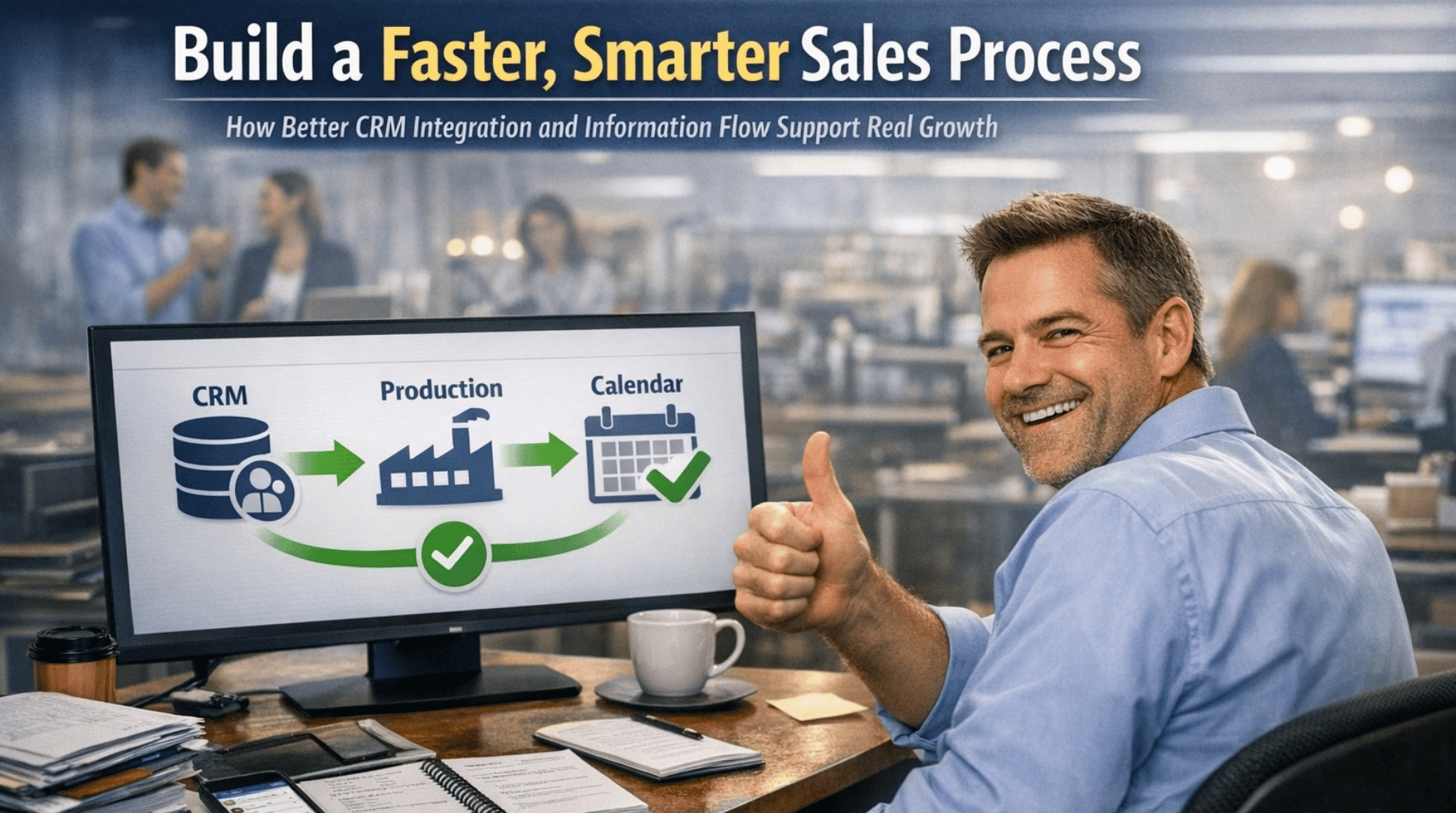
How Better CRM Integration and Information Flow Support Real Growth
Sales leaders are often told the solution is simple: get more leads, hire more reps, or improve follow-up.
Sometimes that is true.
But many businesses do not have a lead problem first. They have a process problem.
More specifically, they have a systems problem.
When your team has to pull information from four different places to prepare for one sales conversation, update one opportunity, or understand what happened next, the process slows down. Admin work piles up. Pipeline visibility gets murky. Forecasting becomes less reliable. And leadership ends up managing growth without trustworthy numbers.
That is where many businesses get stuck.
You want more consistency. You want a more predictable sales motion. You want a CRM that actually helps the team. But if your systems do not support the process, growth becomes harder than it needs to be.
At Succurri, we see this as a business process automation and systems integration challenge. The sales process is not just about people or activity. It is also about how well your systems help information move.
You Cannot Grow Without the Numbers
Growth goals sound good in a planning meeting.
- Grow 20%
- Expand into a new market.
- Increase close rates.
But those goals only become real when the business can measure what is happening clearly.
If leadership cannot see reliable pipeline activity, handoff points, response times, lead sources, follow-up consistency, or opportunity movement, then growth targets are based more on optimism than operational visibility.
That is why the numbers matter.
And that is also why disconnected systems create so much trouble. If your CRM is incomplete, your reporting is delayed, and your team is maintaining context manually across multiple platforms, the numbers lose value fast.
You cannot grow with confidence if your information is fragmented.

The Hidden Cost of Sales Admin Debt
One of the most common issues in growing businesses is what we call sales admin debt.
It is the accumulation of small, repetitive, manual tasks that should not require so much effort but somehow do:
- looking up contact and company details in multiple systems
- copying information from one platform to another
- manually updating CRM records after each interaction
- checking spreadsheets for reporting context
- piecing together activity history before the next call
- chasing down internal handoffs that should already be visible
Individually, each task feels manageable.
Together, they create drag.
Sales admin debt steals time from actual selling. It slows follow-up. It increases the chance of missed information. It hurts CRM adoption because the system starts to feel like an obligation instead of a tool. And it limits leadership visibility because the data is late, incomplete, or inconsistent.
If your team feels busy but leadership still cannot see what is really happening, sales admin debt is often part of the problem.
Why Information Flow Matters More Than Most Businesses Realize
A CRM is only as useful as the information flowing into it.
That sounds obvious, but it is where many businesses fall short.
A CRM does not become powerful because it has a lot of fields or dashboards. It becomes useful when the right information gets there at the right time, in a format the team can actually use.
That means your sales process depends on more than the CRM itself. It depends on how that platform connects to:
- prospecting and enrichment tools like ZoomInfo
- inbound lead sources and forms
- marketing attribution and campaign data
- internal task or ticket workflows
- reporting processes
- proposal or onboarding handoffs
- follow-up and nurture automation
If those pieces do not connect well, your team ends up compensating manually.
That is not scale. That is friction with a software subscription.
Structured Sales Process Is an Evolution
A strong sales process is not built all at once.
It usually evolves in stages.
At first, a company is simply trying to capture activity. Notes are entered, contacts are stored, and the CRM acts mostly like a record-keeping system.
Then the next challenge appears: the team needs consistency. Stages need meaning. Handoffs need clarity. Follow-up needs accountability.
Then leadership wants better reporting. Which leads are converting? Where are deals stalling? What is the team doing well? Where is the pipeline leaking?
Then the organization realizes something important: better reporting depends on better process, and better process depends on better system support.
That is where automation and integration become essential.
Once systems are connected and routine work is reduced, the CRM becomes more than a place to store information. It becomes part of the operating system for how sales actually runs.
That evolution is what supports more predictable growth.
Why This Is an IT Conversation
This is the part many businesses do not expect.
When sales process breaks down, most companies immediately think about hiring more salespeople, changing marketing agencies, or putting the team through training.
Those may all be valid decisions, but sometimes the underlying issue is not effort or intent. It is system design.
If your CRM does not connect cleanly to the tools and workflows around it, then your team is forced to work harder just to maintain momentum. That creates inconsistency even when the people are capable and committed.
This is why Succurri talks about topics like this as an IT provider.
We are not trying to be a sales training firm.
We are addressing the systems behind the process.
This is where engineering systems integration and process automation matters. It is also where practical IT leadership becomes a business growth function, not just a support function. When technology is aligned to how your sales and marketing teams actually operate, the business gains speed, visibility, and a stronger foundation for execution.
HubSpot, ZoomInfo, and the Practical Side of Integration
Tools like HubSpot and ZoomInfo can be powerful. But like any platform, their value depends on how they are implemented, connected, and maintained.
A common mistake is assuming that buying the tool solves the problem.
It does not.
If data is not flowing where it should, if workflows are inconsistent, or if the CRM still depends on too much manual upkeep, even good tools will underperform.
The real value comes from:
- reducing manual re-entry
- enriching records automatically where appropriate
- improving visibility into lead and opportunity activity
- supporting better task flow and next-step ownership
- making dashboards more accurate because the underlying process is cleaner
In other words, the goal is not “more software.” The goal is a cleaner, faster, more usable process.
What a Smarter Sales Process Makes Possible
When your systems support the process well, several things start to improve:
Salespeople spend less time gathering context and more time acting on it.
Managers gain better visibility into the pipeline without chasing updates.
Leadership can make more informed growth decisions based on cleaner information.
Marketing and sales alignment improves because the handoff points are easier to track.
CRM adoption gets better because the system becomes more useful instead of more burdensome.
And perhaps most importantly, the business starts building a process that can actually support its growth goals.
A goal like 15% annual growth becomes much more practical when your sales system is structured, measurable, and less dependent on manual workarounds.
Succurri’s Perspective
At Succurri, we believe in testing these kinds of improvements on ourselves first.
Like many businesses, we have gone through our own evolution of refining process, improving CRM usage, reducing friction between tools, and building better information flow across sales and marketing systems.
That experience shapes how we approach client work.
We focus on practical business outcomes:
- less friction
- better visibility
- cleaner workflows
- stronger process support
- more confidence in the numbers
Because at the end of the day, sales performance is not only about what your team does. It is also about whether the business has built systems that help them do it well.
Some Additional Thoughts
“If your sales process feels slower, messier, or less predictable than it should be, the answer may not be more effort. It may be better information flow or fewer disconnected tools. It may be a more intentional process supported by business process automation and systems integration”
- Grant Eckstrom
Your CRM should help your team sell. It should help leadership see. It should help the business grow with more confidence.
If it is not doing that today, the problem may not be the platform itself. The problem may be the process and systems around it.
Want Help?
If your team is buried in manual sales admin, limited visibility, or disconnected workflows, schedule an IT consultation with Succurri to evaluate where automation and systems integration can improve execution.